Proprietary ANPR parking system using standard IP cameras instead of dedicated ANPR cameras costing €2,000+ per unit. Automatic license plate recognition, billing, PWA mobile app and real-time dashboard — with up to 80% hardware savings.
80% hardware savings: standard IP cameras from €80–€200 instead of dedicated ANPR cameras at €2,000–€3,500 each.
Proprietary software: in-house license plate recognition engine with 97%+ accuracy, continuously updated without hardware replacement.
Full automation: unattended entry and exit, automated fee calculation, push notifications and barrier integration.
PWA app: manage your parking from your phone — monitoring, payments, reports and vehicle whitelists.
An ANPR parking system (Automatic Number Plate Recognition, also called LPR — License Plate Recognition) is an automated parking management system that uses IP cameras and software to recognize the license plates of vehicles entering and leaving a car park in real-time. Unlike traditional ANPR systems based on dedicated cameras costing €2,000–€3,500 per unit (total first-year deployment €25,000–€40,000 for a 4-camera 100-space car park), the GMWEB solution works with standard ONVIF-compatible IP cameras at €80–€200 per unit, bringing the full first-year cost down to €5,000–€7,500 — up to 80 percent lower. License plate recognition runs locally on an edge box with end-to-end latency below 100 milliseconds, keeping data GDPR-compliant (no foreign cloud). The system automatically opens barriers for authorized vehicles, calculates parking fees, generates real-time occupancy reports and delivers a PWA mobile app for both parking operators and drivers. Deployment takes 7–14 business days. Target markets: private car parks, hotels, paid parking facilities, shopping centres, residential communities and ANPR barrier-system operators across the UK, Germany, Poland and the rest of Europe.
Parking operators lose money on expensive hardware, manual handling and the absence of occupancy data.
€2,000+
Dedicated ANPR cameras run €8,000–€15,000 for a typical 4-point installation. This entry barrier eliminates small and mid-sized parking operators.
30+ sec.
Paper tickets, guard booths, manual barriers. Queues at entry and the cost of 24/7 staffing.
0%
Without a digital system you have no data on occupancy, vehicle rotation or revenue. You cannot optimize pricing or plan expansion.
A complete solution from license plate recognition through automated billing to the mobile app.
Proprietary software analyzes IP camera footage in under 100 ms with 97%+ accuracy. Supports European and international plates.
Standard IP cameras for €80–€200 instead of dedicated ANPR cameras starting at €2,000. Up to 80% hardware savings with comparable accuracy.
Progressive Web App for parking owners and drivers. Monitoring, payments, visit history and push notifications — no app store install required.
Fee calculation based on parking duration. Integration with Stripe, PayPal, Adyen and local payment gateways. Invoices and revenue reports.
Live occupancy view, entry/exit history, alerts for unauthorized vehicles and statistical reports at your fingertips.
Whitelists for hotel guests, residents and staff. Automated entry without operator intervention — the barrier opens on its own.
We install dedicated devices or adapt your existing camera and network infrastructure. Flexibility tailored to your car park.
Works with CAME, BFT, FAAC, Nice and Beninca barriers. Automated opening for authorized vehicles via relay interface or API.
Works with any ONVIF-compatible IP camera from Hikvision, Dahua, Axis, Reolink, Uniview, TP-Link VIGI, Bosch, Vivotek or Hanwha. Auto-discovery on local network, RTSP streaming, no vendor lock-in — reuse existing CCTV hardware.
End-to-end recognition latency under 100 milliseconds per plate, barrier opens in under 500 ms. Live dashboard via WebSocket — occupancy counter, entry/exit feed and revenue stream update under 1 second. 60+ plates per second with optional AI accelerator.
Three steps from vehicle arrival to automated decision — in under 100 milliseconds.
An IP camera with IR illumination records the license plate of the arriving vehicle — day and night.
The proprietary GMWEB algorithm analyzes the image and reads the plate number with 97%+ accuracy in under 100 ms.
Automated barrier opening, fee calculation start or alert dispatch — without any operator involvement.
Up to 80% hardware savings with comparable license plate recognition accuracy.
| Dedicated ANPR cameras | GMWEB system (IP cameras) | |
|---|---|---|
| Cost of one camera | €2,000 – €3,500 | €80 – €200 |
| Cost of 4 cameras | €8,000 – €14,000 | €320 – €800 |
| Software | License €1,200+/year | Included in subscription |
| Recognition accuracy | 99% | 97%+ |
| Real-time latency | 200–400 ms | < 100 ms |
| ONVIF compatibility | Vendor-locked | ONVIF Profile S / T / G |
| PWA mobile app | Not available or extra | Included |
| Automated billing | Additional module | Included in Business |
| First-year total (4 cams, 100 spaces) | €25,000 – €40,000 | €5,000 – €7,500 |
| Total savings | — | Up to 80% |
Private car park in Łańcut (southeastern Poland) — a deployment covering two IP cameras (entry and exit), a proprietary ROI (Region of Interest) configuration panel and integration with an existing barrier. Completed and running in production since March 2026.
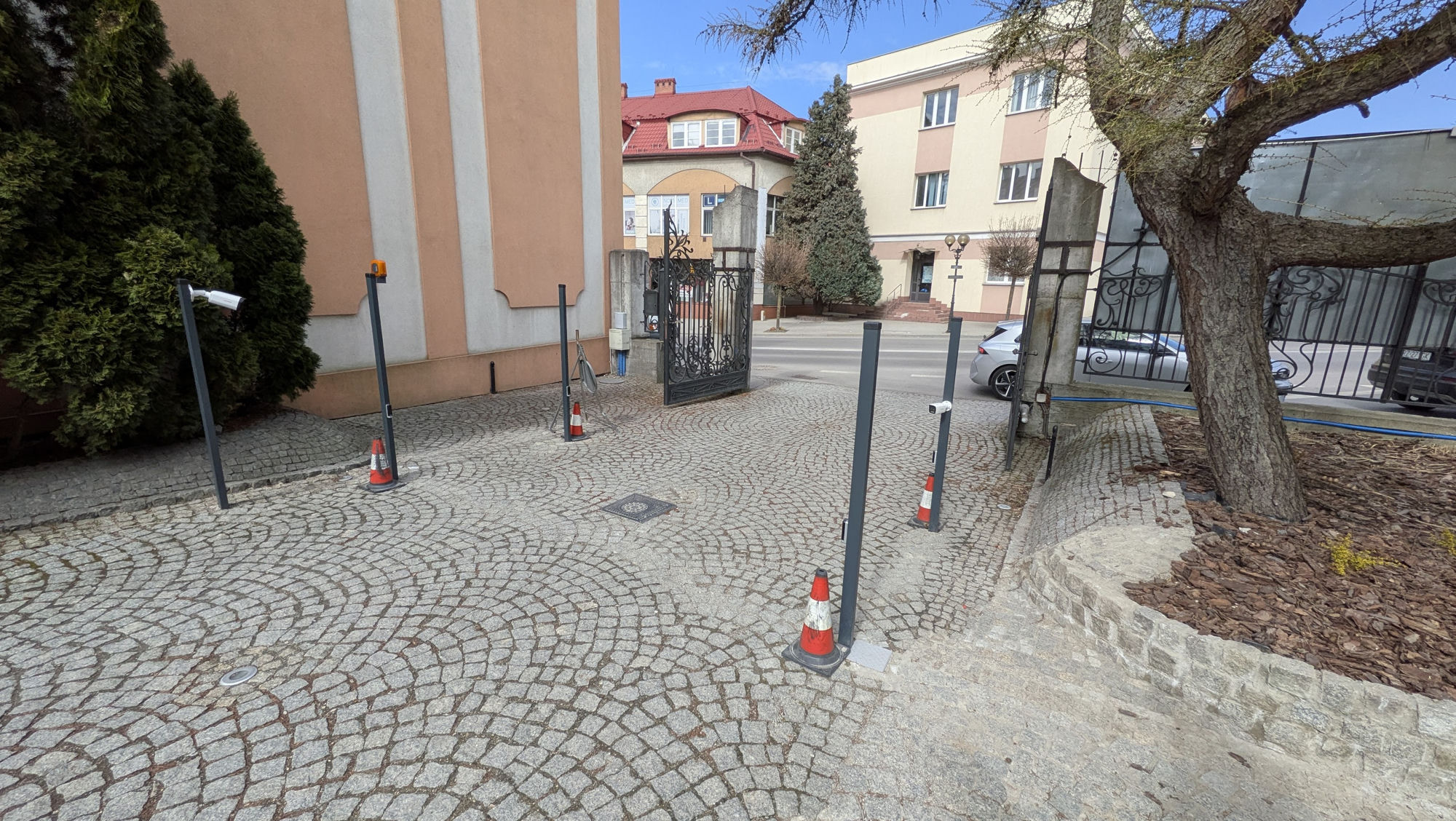
Two control points (entry and exit) served by IP cameras with IR illumination, mounted on the existing infrastructure without any interference with the building facade. Automated barrier integrated via relay interface.
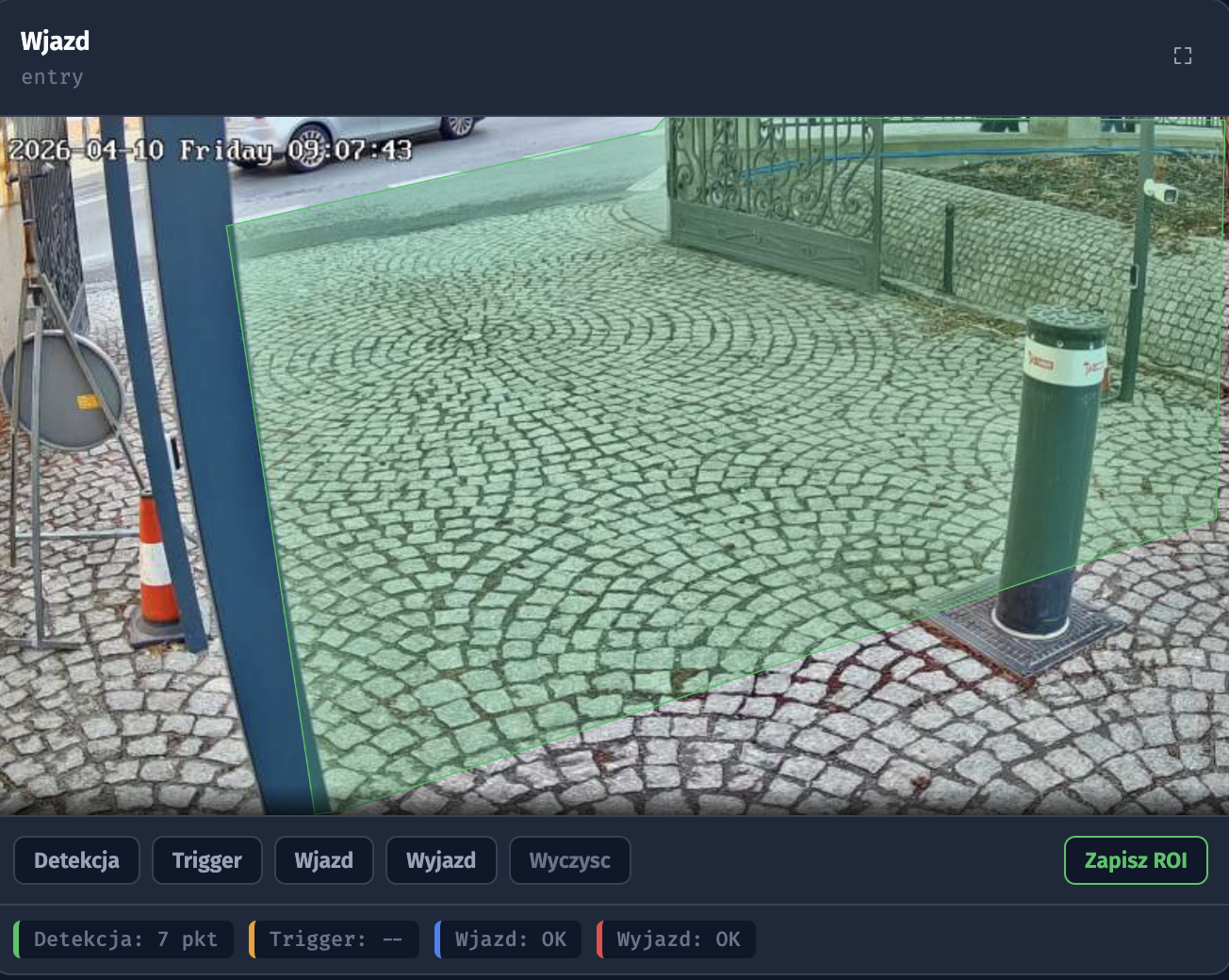
Proprietary Region of Interest (ROI) configuration panel — defines the license plate scanning area. 7 detection points, Entry: OK / Exit: OK status in real time.
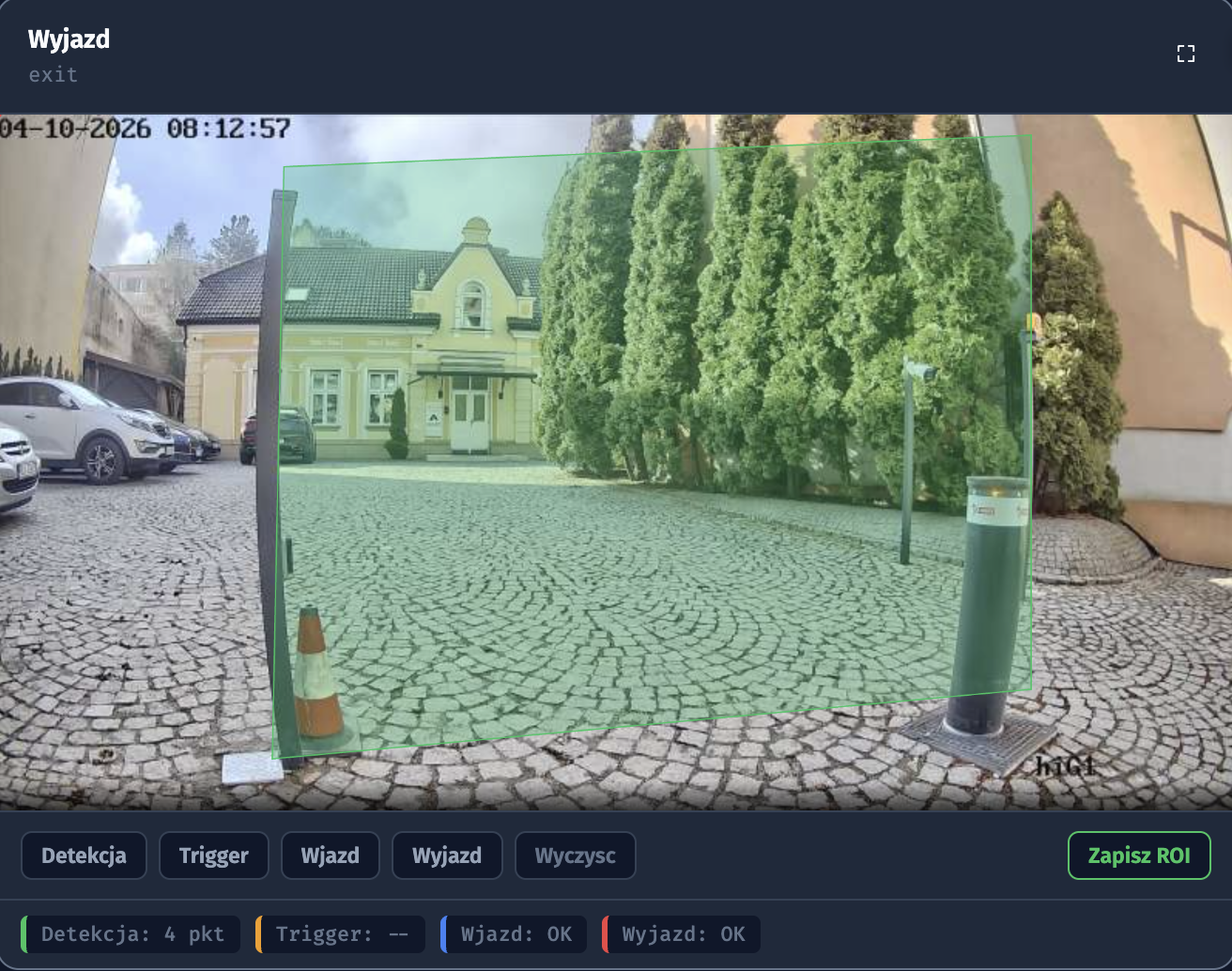
Second camera handling the car park exit — independent ROI configuration, Trigger, Entry, Exit buttons and detection region saving. Dedicated GMWEB admin interface.
2
Control points (entry + exit)
< 7 days
Deployment time from audit to launch
~85%
Savings vs dedicated ANPR cameras
From private car parks to hotels and residential communities — anywhere automated entry and exit delivers real savings.
Gated communities, office buildings, shopping centers. Access control based on vehicle whitelists, traffic monitoring and occupancy reports for the property manager.
Automated guest authorization by license plate linked to the reservation. Integration with the hotel PMS, unattended entry and exit without reception involvement.
Full automation of fee calculation, unattended entry and exit, online payments via PWA. Eliminate paper tickets and cash handling.
Manage parking spaces for residents, time-limited guest lists, reports for the community administrator and automated access control.
Progressive Web App available on any device without installing from an app store. Add it to your home screen and use it like a native app.
The core features — license plate recognition and barrier control — run locally, independent of internet connectivity. Data syncs automatically once the connection is restored.
The PWA opens directly in the browser. Your customers don't need to download anything — a link or QR code at the car park is all it takes.
Transparent hardware and network specifications — know exactly what you need before deployment.
Compatible models: Hikvision, Dahua, Reolink, Uniview, TP-Link VIGI. We help you pick the right model.
We supply a pre-configured edge box or deploy on your own hardware. All processing happens locally.
Typical transfer: ~1–3 GB per day per camera (events and thumbnails only, not continuous streaming).
A license plate number is personal data within the meaning of GDPR (Art. 4(1)). The GMWEB system is designed according to the privacy by design principle — data is stored locally, encrypted and automatically deleted after the configured retention period.
We help parking owners prepare the full GDPR documentation: record of processing activities, information clauses for users and a data protection impact assessment (DPIA) for entry monitoring.
Legal basis
Legitimate interest of the controller (Art. 6(1)(f) GDPR) — access control and asset security.
Data retention (configurable)
By default: license plates 30 days, event images 14 days, access logs 90 days. Automatic deletion after the period ends.
Data security
Database encryption (AES-256), TLS 1.3 for transmission, role-based access control, administrator login audit trail.
Storage location
Data stays locally on the customer's edge box — no transfer to foreign cloud. The cloud is only used for metadata sync and dashboard.
Rights of data subjects
The admin panel handles access, rectification, erasure and processing restriction requests — directly from the dashboard.
Anonymization after retention
Once the retention period ends, data is irreversibly deleted or anonymized for statistical purposes (entry count only, no vehicle identification).
From audit to launch in 7–14 business days.
We analyze your car park — entry layout, existing cameras, lighting conditions. We design the optimal camera layout and system architecture.
We install IP cameras with IR illumination at the control points. If you already have cameras, we check whether they can be reused.
We deploy the plate recognition software, create vehicle whitelists and configure parking rules.
We connect payment gateways, configure rate cards and automated fee calculation. We integrate your barrier.
We test license plate recognition accuracy in daylight and at night. We calibrate cameras and tune system parameters.
We train your team on the dashboard and mobile app. We provide ongoing technical support and system monitoring.
Plans are fully adjustable. After a call we will prepare a detailed quote taking into account your existing infrastructure.
Up to 2 cameras, up to 50 spaces
Up to 6 cameras, up to 200 spaces
Unlimited cameras and spaces
97%+
Recognition accuracy
80%
Hardware savings
<100ms
Plate recognition time
24/7
Monitoring and support
Have more questions? Email us at info@gmweb.pl or call +48 781 339 252.
An ANPR parking system (Automatic Number Plate Recognition) is an automated parking management solution based on license plate recognition. An IP camera mounted at the entry captures the vehicle's image, and the proprietary GMWEB software analyzes it in under 100 milliseconds, reading the license plate number. Based on the result, the system makes an automatic decision — it opens the barrier for authorized vehicles, starts parking fee calculation or sends an alert to the operator. The entire process happens without any parking staff involvement. The system logs every entry and exit in its database, providing the parking owner with a dashboard showing real-time occupancy, event history and reports through the PWA mobile app.
Dedicated ANPR cameras cost €2,000 to €3,500 per unit, which means spending €8,000–€14,000 on hardware alone for a typical 4-point parking installation. The GMWEB system uses standard IP cameras priced at €80–€200 per unit, and license plate recognition is handled by proprietary software running on a local server. This reduces total hardware cost by around 80 percent while maintaining recognition accuracy above 97 percent. Another advantage is flexibility — IP cameras are widely available, easy to replace and can simultaneously serve as a general video monitoring system. The GMWEB software is continuously developed and updated, enabling accuracy improvements without any need to replace hardware.
License plate recognition accuracy in the GMWEB system exceeds 97 percent under standard lighting and weather conditions. Accuracy depends on factors such as camera angle, distance from the vehicle, lighting conditions and plate condition. The system handles European and international plates, including temporary and diplomatic plates. For unreadable plates — for example covered with snow or mud — the system flags the event as requiring verification and sends a notification to the operator. IP cameras with built-in infrared (IR) illumination ensure proper operation at night as well. Regular camera calibration and software updates allow us to maintain high accuracy year-round.
The cost of deploying the GMWEB ANPR parking system depends on the scale of the car park and chosen features. The Start plan, designed for small car parks of up to 50 spaces with a maximum of two cameras, starts at PLN 1,500 net per month. The Business plan for parking facilities up to 200 spaces with six cameras, automated billing and barrier integration starts at PLN 2,200 net per month. For larger facilities we prepare individual quotes. Hardware cost — IP cameras, cabling and an optional local server — is billed one-time and depends on the existing infrastructure. In many cases we can reuse cameras the parking already has. For a typical 100-space car park, return on investment occurs within 6–12 months thanks to elimination of manual handling costs.
A standard ANPR parking system deployment takes 7 to 14 business days from contract signing. The process begins with a car park audit, during which our technicians analyze the entry and exit layout, existing camera and network infrastructure and lighting conditions. Based on the audit we design the optimal camera layout and system architecture. IP camera installation and network configuration usually takes 1–2 business days. Next, we install and configure the software, create authorized vehicle lists, set parking rules and integrate the payment system. After configuration we run license plate recognition tests and train staff on the dashboard and mobile app. For simple single-camera installations, deployment can be completed in as little as 3–5 business days.
Yes. The GMWEB system runs 24/7 thanks to IP cameras with built-in infrared (IR) illumination, which ensures a readable license plate image even in complete darkness. Infrared light reflects off the reflective surface of the plate, producing strong contrast between characters and background regardless of the time of day. In rain and fog the system maintains above 95 percent accuracy, because the software algorithm compensates for image interference. During heavy snowfall accuracy may drop temporarily, especially when snow covers the plate — in such cases the system automatically flags the event for manual verification. We recommend mounting cameras under a canopy, which additionally protects the hardware and improves reading quality.
The GMWEB parking app is a Progressive Web App (PWA) that runs directly in the browser on any device — smartphone, tablet or desktop — without installing from an app store. For parking owners the app offers real-time occupancy view, entry and exit history, authorized vehicle list management, revenue reports, occupancy statistics and push notifications for unauthorized vehicles. For drivers — parking users — the app allows checking available spaces, paying for parking online, viewing visit and receipt history and receiving notifications when the paid time is about to expire. The PWA loads instantly, works offline with automatic data sync once the connection is restored, and can be added to the phone's home screen like a native app.
Yes. The GMWEB system integrates with most popular parking barriers available in Europe, including models from CAME, BFT, FAAC, Nice and Beninca. Integration is done via a relay interface — our controller is connected to the existing barrier control unit, enabling automated opening and closing based on license plate recognition results. For newer barriers with network interfaces, direct API integration is possible without additional hardware. If your parking does not yet have a barrier, we help select the right model and deliver a complete installation. The system can also run without a barrier — monitoring and vehicle logging only — which is popular at hotel car parks, where a barrier is not needed and the system serves for automated guest identification.
Automated billing in the GMWEB system works by recording entry and exit times based on the license plate number. When a vehicle enters the parking, the system recognizes the plate and logs the exact entry time. On exit it reads the plate again, calculates the parking duration and charges the fee according to the configured rate card — hourly, daily or subscription rates. The driver can pay through the PWA app, an online payment gateway or a payment terminal. The system automatically generates invoices and receipts, stores transaction history and provides revenue reports to the parking owner. For whitelisted vehicles — hotel guests, staff, residents — the system skips fee calculation and opens the barrier automatically. Integration with Stripe, PayPal and Adyen ensures smooth billing.
The GMWEB parking system requires internet access for full functionality — the online dashboard, PWA app, online payments and remote management. However, the core functions such as license plate recognition and barrier opening run locally on a dedicated device installed at the parking, independent of the internet connection. In case of temporary internet loss the system continues to operate in offline mode — it recognizes plates, opens barriers for authorized vehicles and logs events locally. Once the connection is restored, data syncs automatically with the cloud. A standard internet link with at least 10 Mbps is sufficient for proper operation. For locations without permanent connectivity we can configure the system with an LTE router as a backup link, ensuring continuous operation even in remote locations.
For the GMWEB ANPR system to work correctly, an IP camera should meet the following minimum specifications: 2 MP resolution (1920×1080 Full HD), 1/2.8-inch or larger sensor with sensitivity below 0.01 lux, minimum 15 frames per second (25 fps recommended), varifocal lens 4–12 mm with a 30–90 degree angle of view, IR illumination with 20–30 meter range using Smart IR and WDR of at least 120 dB, RTSP and ONVIF Profile S protocol support, H.264 or H.265 encoding, PoE power supply compliant with IEEE 802.3af or at, and an IP66 or IP67 enclosure rated for operating temperatures from −30 to +60 degrees Celsius. Compatible models are available from most manufacturers — Hikvision, Dahua, Reolink, Uniview and TP-Link VIGI. During the audit we help pick the optimal model for your car park.
The local server (edge box) is the heart of the system — it performs license plate recognition without sending images to the cloud. Minimum configuration includes an Intel N100, i3-12100 or ARM Cortex-A76 processor, 8 GB of RAM (16 GB for four or more cameras), a 256 GB NVMe SSD, two Gigabit Ethernet ports, GPIO for barrier control and 230 V AC power at 30–65 W. Optionally an AI accelerator (Google Coral TPU or NVIDIA Jetson) can be added to speed up recognition under heavy traffic. The edge box runs on Debian 12 Linux or Ubuntu 24.04 LTS and comes in a fanless enclosure for 1U RACK or DIN rail mounting. A UPS is recommended for continuous operation. GMWEB supplies a pre-configured edge box or deploys the system on the customer's existing server.
Yes, the GMWEB system is fully GDPR-compliant. A license plate is personal data within the meaning of Art. 4(1) GDPR, which is why the whole system has been designed according to the privacy by design principle. The legal basis for processing is the legitimate interest of the controller (Art. 6(1)(f) GDPR) — access control and asset security. Default retention periods are: license plates 30 days, event images 14 days, administrator access logs 90 days — all periods are configurable by the parking owner. After the period expires, data is automatically and irreversibly deleted. The database is encrypted with AES-256, transmission is secured by TLS 1.3. Data stays locally on the customer's edge box — it is not transferred to a foreign cloud. The admin panel handles access, rectification, erasure and processing restriction requests. We help prepare complete GDPR documentation, including the record of processing activities and information clauses.
Total ANPR parking system cost splits into three components: (1) HARDWARE one-time — dedicated ANPR cameras cost €2,000–€3,500 per unit (typical 4-point installation = €8,000–€14,000 in cameras alone), GMWEB uses standard ONVIF-compatible IP cameras at €80–€200 per unit (4-point = €320–€800), plus a local edge box €400–€1,200 (Intel N100 or ARM Cortex-A76 with 8 GB RAM). (2) SOFTWARE recurring — competitor ANPR software licenses run £1,000–£5,000 per year (UK market), GMWEB software is included in the monthly subscription starting at PLN 1,500 / €350 net/month (Start plan, up to 2 cameras, 50 spaces). Business plan €500/month (6 cameras, 200 spaces, automated billing, barrier integration). (3) DEPLOYMENT one-time — audit, installation, network configuration, software setup, integration testing and staff training, typically 7–14 business days. Total first-year cost for a 4-camera 100-space installation with GMWEB: roughly €5,000–€7,500 including hardware, deployment and first year subscription — about 70–80 percent lower than traditional dedicated-ANPR deployments at €25,000–€40,000. ROI typically 6–12 months through eliminated manual handling.
Yes — free and open-source license plate recognition (LPR) software exists, primarily OpenALPR (open source core on GitHub, cloud pricing for the commercial version), Plate Recognizer (free developer tier, ~2,500 lookups/month), SimpleALPR and academic TensorFlow / YOLO-based projects. Free LPR is a reasonable choice for learning, research, proof-of-concept builds or hobby projects with up to one camera and no SLA requirement. For a commercial parking operator, free software is usually insufficient because it lacks: (1) a production dashboard and PWA app, (2) barrier hardware integration (CAME, BFT, FAAC, Nice, Beninca), (3) automated billing and payment integration (Stripe, PayPal, Adyen), (4) a 24/7 SLA with uptime guarantees, (5) GDPR-compliant data retention workflows with automatic purging, (6) commercial support in case of recognition errors affecting revenue. GMWEB builds on the same open-source foundation (YOLO-based detection) but adds the complete parking-operator stack, reaching above 97 percent accuracy with production reliability — at a cost still 70–80 percent lower than dedicated ANPR hardware vendors.
Yes. The GMWEB ANPR parking system is fully ONVIF-compatible and works with any IP camera supporting ONVIF Profile S (real-time streaming), Profile T (advanced video streaming with H.265 and bi-directional audio) and Profile G (video storage and retrieval). This means you can use IP cameras from virtually any manufacturer — Hikvision, Dahua, Axis, Reolink, Uniview, TP-Link VIGI, Bosch, Vivotek, Hanwha (Samsung) — without being locked to a single brand. ONVIF is the industry-standard protocol that ensures cameras can communicate with our recognition software regardless of vendor. The system auto-discovers ONVIF cameras on the local network during setup, eliminating manual IP configuration per camera. RTSP (Real Time Streaming Protocol) is used for low-latency video feed ingestion into the recognition engine. If you already have an ONVIF-compatible CCTV system at the car park, we can reuse existing cameras — no need to replace hardware. During the audit we verify ONVIF profile support and camera specifications (resolution, IR illumination, WDR) to confirm suitability for license plate recognition.
Yes — the GMWEB ANPR parking system processes every vehicle in real-time with end-to-end latency under 500 milliseconds from camera capture to barrier opening. Breakdown: license plate recognition (RTSP stream → plate string) runs in under 100 ms on the local edge box, database lookup against the whitelist / billing rules takes under 50 ms, barrier relay signal fires in under 150 ms (hardware-dependent). For unattended parking this is imperceptible to drivers — the barrier lifts as the vehicle approaches, with no stopping and no ticket. Real-time processing also means the dashboard updates live: occupancy counter, entry/exit feed, alerts for unauthorized vehicles and the revenue counter all stream via WebSocket to the PWA app with sub-second updates. Processing happens locally on the edge box (not in a foreign cloud), which keeps latency low regardless of internet connection quality and guarantees GDPR-compliant local data residency. During heavy traffic peaks (e.g., event venues), an optional AI accelerator (Google Coral TPU or NVIDIA Jetson) raises throughput above 60 plates per second per camera.
Automate your parking today
During a free consultation we will show you how the ANPR system with IP cameras will work on your car park. We will prepare a project, cost estimate and deployment timeline.
Complete guides for every aspect of ANPR parking — from camera selection to use-case specific implementations.
Profile S/T/G, 10 compatible brands, RTSP setup, troubleshooting. 2,400 words.
Read guideYear-1 breakdown (€5-8k GMWEB vs €25-40k dedicated), 3-year TCO, UK/EU/US pricing, ROI calculator.
See pricingOpenALPR (free) vs Plate Recognizer vs Vaxtor vs Genetec vs GMWEB. Accuracy benchmarks, APIs, GDPR.
ComparePMS integration (Mews/Opera/Cloudbeds), guest whitelist, overstay billing. €350/month.
Hotel use caseHOA database sync, visitor QR pass 30-sec workflow, delivery fleet recognition, anti-passback security.
Residential use casePOS validation for free parking, tenant employee portal, tiered loyalty, dynamic pricing, HC+EV enforcement.
Retail use case